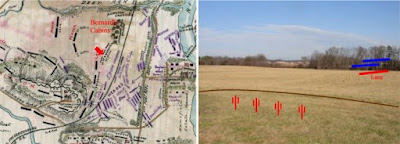
A small sign along the Fredericksburg tour road marks the trail to Bernard’s Cabins. The cabins no longer exist, but I will hike any reasonable distance to see an artillery position. I’ve been fascinated by Civil War artillery since I was old enough to climb on cannons (not an endorsement, mind you). My wife can identify a Napoleon, and sometimes a Parrot Rifle. The sun was out and the temperature had reached the mid-40’s, so I set out through the woods in hopes that the gun position had not been lost to development or tree growth.
I emerged from the woods in a large clearing extending to the Richmond, Fredericksburg, and Potomac Railroad embankment and the open ground of the Slaughter Pen Farm to the east. The ground rises from the edge of the woods, forming a knoll several hundred yards from the railroad embankment. Here, Captain Greenlea Davidson directed the fire of three batteries. Bernard’s Cabins, which the gunners tore down to clear their field of fire, had been home to slaves working one of the larger plantations in the area.
Davidson’s gunners endured a fierce bombardment by Federal artillery under the command of Charles Wainwright followed by infantry assaults directed by Meade and Gibbon that. To make matters worse, one of Davidson’s batteries was supplied with defective ammunition and had to be withdrawn.
The rebel cannon were supported by troops of A.P. Hill’s division deployed to their right front along the railroad and in trenches to their rear. Meade and Gibbon exploited a gap in Hill’s lines and nearly carried his lines. James Lane’s brigade was driven back from the railroad embankment in disorder and Gibbon’s Federal troops surged into the woods beyond, threatening to turn Davidson’s gunners out of their position.
Several batteries under Latimer deployed on Davidson’s left, and a timely counterattack by Edward Thomas’s Georgia brigade. Under pressure from Thomas’s men and scathing volleys of canister from Davidson’s gunners, Gibbon’s assault lost momentum. Without support, Gibbon reluctantly withdrew his troops and Thomas, along with rallied elements of Lane’s command, reestablished the Confederate line along the railroad embankment.
The batteries under Davidson’s command maintained their position throughout the battle.